
buckling the seatbelt…
Unit 07 · Forces & Motion arc · 7th grade
This unit is Newton's three laws of motion — the rules behind everything that starts, stops, speeds up, or pushes back. We're learning them because they explain your seatbelt, your skateboard, and every rocket ever flown. One crash-test dummy volunteered to demonstrate. It did not get a choice.
welcome from Mr. U · stand-in video — the real one lands soon
Watch · Khan Academy
Manipulative · Spaced repetition
Twenty-two words plus myth cards, on a brain-aware schedule. Flip, type, or match them, listen if you like, and the deck brings each word back right when you're about to forget it. More units join your deck as we unlock them — scan the sketchnote's QR to open tonight's review. (It lives in your browser, no account.)
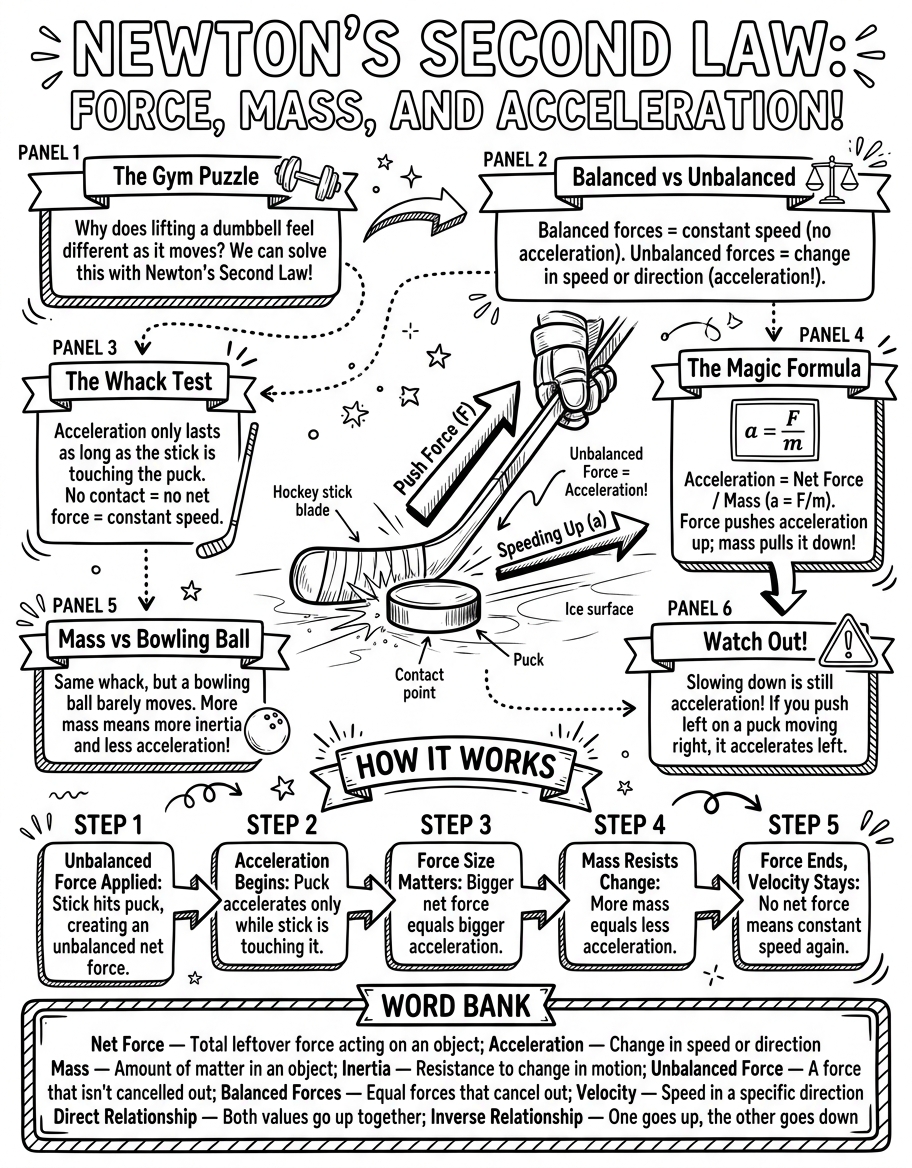
inertia · acceleration · net force · mass · unbalanced force · balanced forces
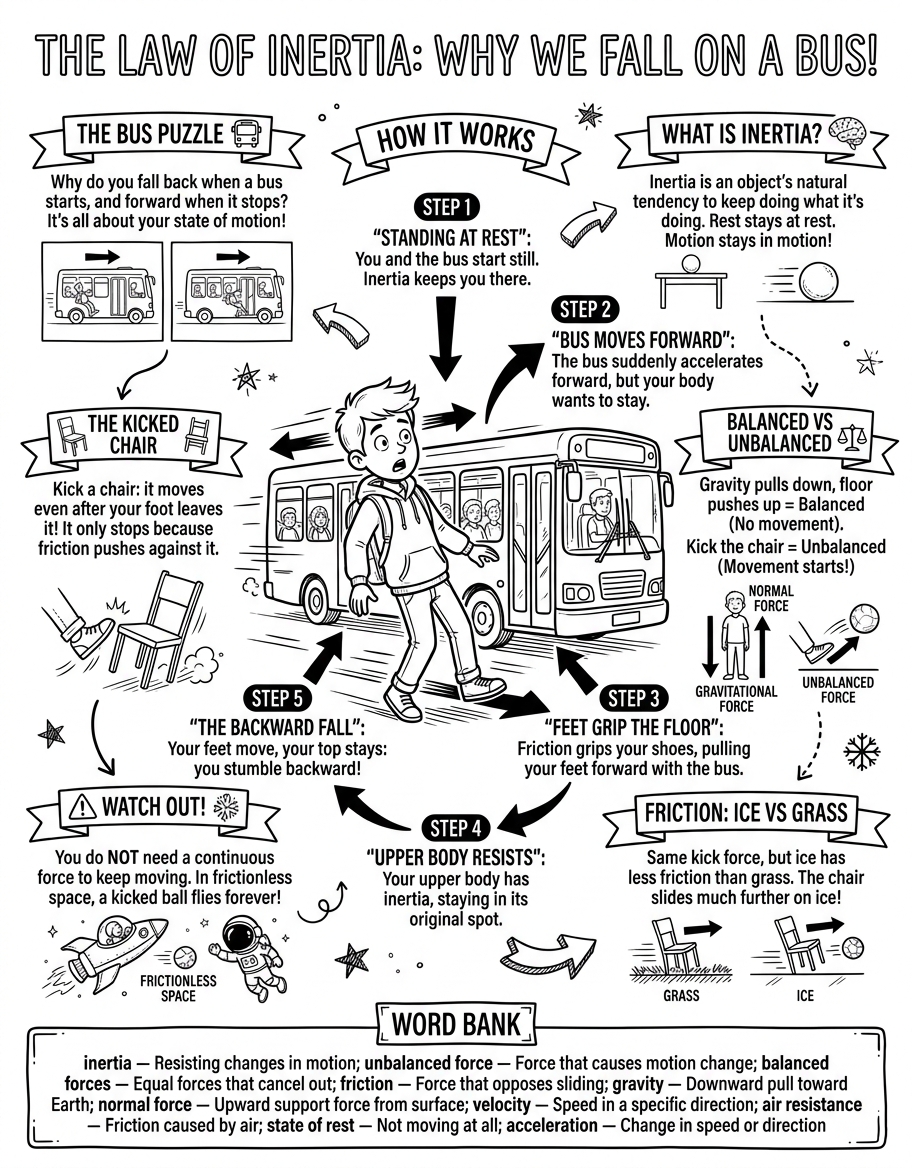
inertia · acceleration · net force · mass · unbalanced force · balanced forces
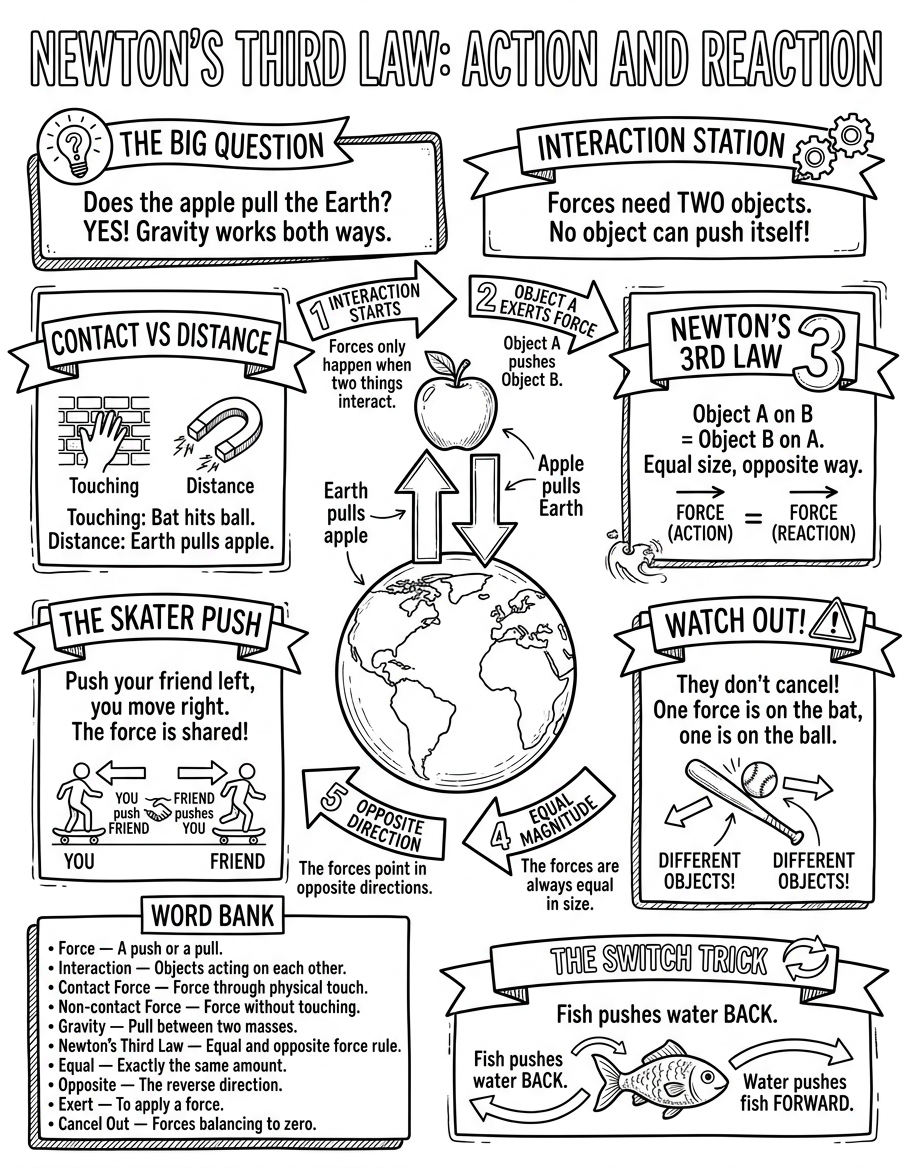
force · interaction · contact force · non-contact force · exert · cancel out · newton's third law
newton's first law · newton's second law · F = ma · action force · reaction force · momentum · seatbelt · frictionless · external force
Terms in more than one group showed up in more than one video — they're listed under each. Sheet-only words (extension) stay on the sketchnotes.
Sketch · sketchnotes
One page per video. Print the workbook, fill it in while you watch, then check yourself against the key. Doodling counts as studying here.
Read · Eleo explains
Companion articles for the videos — same laws, beetle's mouth. Read them before or after; he doesn't grade order. Audio versions land as they're recorded.
Investigate · Performance expectations
Four investigations, one rule: commit first. Draw the graph, design the car, say the claim — then let the data reply. Your prediction stays on screen underneath. Export your work at the end and turn it in.
Ride, brake, and read your own inertia in the accelerometer trace — your data, your graph, your upload.
real data · you collect it Open the lab → MS-PS2-2 · modelingThe motion is visible; the force is hiding in it. Draw what you think it does, then watch the model disagree — or not.
labeled model · says so on the page Open the investigation → MS-PS2-2 · planning investigationsDouble the speed and the stopping distance doubles — right? Draw your line first. The data lands on top of it.
labeled model · says so on the page Open the investigation → MS-PS2-1 · engineering designYou can't change the forces — the third law fixes those. Change how long the crash lasts. Keep the person under 35 g.
labeled model · real test ranges cited Open the challenge →Practice · Math skills
One law, three disguises — solve for force, mass, or acceleration, then meet the ×4 stopping rule and the crash math. Print the sheet, show your work, check the key.
Myth-busters · tap to flip
Exit ticket · 5 questions
No grade, no stakes — just proof the laws stuck. Answer all five to earn the stamp.
The phenomenon · run the test
The car hits the wall at 56 km/h and stops in about a tenth of a second. The dummy? The dummy keeps moving at 56 km/h — until something provides a force to stop it. Run the test both ways and watch what the seatbelt is really for.
belt on: the belt jolts the dummy to a stop WITH the car — one system, one deceleration.
Nobody pushed the dummy forward. It just kept doing what it was already doing — moving at 56 km/h. The car had a wall to stop it; the dummy only had whatever touched it. That's the whole first law in one crash: motion keeps itself until a force says otherwise. The seatbelt isn't decoration — it's the assigned stopping force.
Law 01 · inertia
An object at rest stays at rest; an object in motion stays in motion — same speed, same direction — unless a net force acts. The tendency is called inertia, and mass is how much you've got. Heavy things are hard to start AND hard to stop.
Yank the cloth fast and the plates stay — their inertia outweighs the friction tugging them. Slow pull, and everything rides along. Speed of the pull decides which force wins.
The bus brakes, you lurch forward — your feet stop with the floor, your head votes to continue. Headrests and seatbelts exist because your body has opinions about continuing.
Tap the leaf he's standing on and he doesn't budge — six hooked feet give him friction enough to stay a system with the leaf. Friction: the beetle's seatbelt.
Law 02 · the lab · F = ma
Acceleration = net force ÷ mass. More push, more zoom; more mass, less zoom. Set the force, set the mass, read the acceleration — then push the cart and watch the math move.
magic frictionless track — the physicist's favorite imaginary surface.
Law 03 · action & reaction
For every force there is an equal and opposite partner. You push the ground back, the ground pushes you forward — that's walking. A rocket pushes exhaust down, the exhaust pushes the rocket up. Nothing pushes the rocket from outside. It pushes its own fuel. Now fly the balloon.
inflate it first. the air is the fuel.
Your foot pushes the ground backward; the ground pushes your foot forward. You don't move the Earth (well, immeasurably); the Earth moves you. The beetle does this six times at once.
Action and reaction act on different objects — you on the ground, the ground on you. Forces only cancel when they're on the SAME object. That's why anything moves at all.
Manipulative · name that law
Standards: MS-PS2-1 — Newton's Third Law and the motion of colliding objects · MS-PS2-2 — the change in motion depends on net force and mass (NGSS Lead States, 2013). DCI: PS2.A Forces and Motion. CCCs: Systems and System Models (action-reaction pairs), Stability and Change (inertia is stability).